Epoxy flooring is a durable, stylish and versatile flooring solution for homes, businesses and industrial properties. Whether you need a hard-wearing garage floor, a modern commercial finish or a heavy-duty industrial surface, epoxy flooring can provide long-term performance with a wide range of colours, textures and finishes.
In addition, modern epoxy flooring is no longer limited to factories and warehouses. Today, it is used in homes, restaurants, offices, retail stores, showrooms, workshops and other commercial environments. As a result, property owners can combine practical performance with an attractive, contemporary finish.
In this complete guide to epoxy flooring, we explain what epoxy flooring is, explore its benefits and applications, compare popular epoxy systems, explain the installation process, discuss maintenance and lifespan, and provide tips for choosing the right epoxy flooring contractor in Cape Town and the Western Cape.
What Is Epoxy Flooring?
Epoxy flooring is a resin-based flooring system created by combining epoxy resin with a hardening agent. Once these components are mixed, they undergo a chemical reaction that forms a tough and durable surface.
Unlike ordinary floor paint, epoxy forms a bonded coating over properly prepared concrete. Therefore, professional surface preparation is one of the most important parts of a successful epoxy flooring installation.
Depending on the selected system, epoxy flooring can provide:
- A seamless surface
- Excellent durability
- Chemical resistance
- Moisture resistance
- Easy maintenance
- Decorative finishes
- Improved concrete protection
- Long-term performance
For more flooring options, explore our concrete flooring solutions.
Why Is Epoxy Flooring So Popular?
There are several reasons why epoxy flooring has become increasingly popular among homeowners, architects, designers and business owners. Firstly, it provides a hard-wearing surface for busy areas. Secondly, it offers extensive design flexibility. Furthermore, its seamless finish can make everyday cleaning easier.
Exceptional Durability
One of the biggest advantages of epoxy flooring is its durability. For this reason, it is particularly suitable for areas exposed to regular traffic and wear.
Depending on the flooring system, epoxy can withstand:
- Heavy foot traffic
- Vehicle movement
- Forklift traffic
- Machinery
- Impact
- Abrasion
- Everyday wear
However, performance depends on several factors, including the epoxy product, concrete condition, surface preparation, installation quality and maintenance.
Chemical Resistance
Industrial and commercial floors can be exposed to oils, fuels, cleaning products and other chemicals. As a result, chemical resistance can be an important consideration when choosing epoxy flooring.
Epoxy can provide strong chemical resistance. However, resistance varies according to the resin system, chemical concentration, exposure time and temperature. Therefore, the flooring system should always be selected according to the conditions of the specific property.
Moisture Protection
Concrete is naturally porous and can absorb moisture. Consequently, moisture management should be considered before installing an epoxy flooring system.
A properly installed epoxy coating can create a protective surface over suitable concrete. Nevertheless, moisture testing remains important because excessive moisture or vapour transmission can affect adhesion and long-term performance.
Modern Appearance
In addition to its performance, epoxy flooring offers numerous design possibilities.
Popular options include:
- Solid colours
- Metallic epoxy
- Decorative flakes
- Quartz finishes
- Marble effects
- High-gloss finishes
- Satin finishes
- Custom colours
- Branded designs
Therefore, epoxy can create everything from a simple industrial floor to a sophisticated designer finish for a luxury home or commercial property.
Where Can Epoxy Flooring Be Installed?
One of the biggest benefits of epoxy flooring is its versatility. For example, epoxy systems can be specified for residential, commercial and industrial environments.
Residential Epoxy Flooring
Homeowners are increasingly choosing epoxy flooring for areas that require a durable and easy-to-clean surface.
Popular applications include:
- Garages
- Home gyms
- Workshops
- Laundry rooms
- Entertainment areas
- Storage rooms
- Basements
- Covered patios
Furthermore, decorative epoxy finishes can transform ordinary concrete into an attractive feature within a modern home.
Commercial Epoxy Flooring
Commercial properties need flooring that can handle daily use while maintaining a professional appearance. For this reason, epoxy flooring can be suitable for many commercial environments.
Applications include:
- Retail stores
- Shopping centres
- Restaurants
- Coffee shops
- Hotels
- Offices
- Reception areas
- Showrooms
- Beauty salons
- Medical practices
In addition, a seamless epoxy surface can make routine cleaning and maintenance more straightforward.
Industrial Epoxy Flooring
Industrial environments can place significant demands on flooring. Therefore, heavy-duty epoxy flooring systems are commonly considered for:
- Warehouses
- Distribution centres
- Manufacturing facilities
- Engineering workshops
- Automotive workshops
- Food production areas
- Logistics facilities
- Storage areas
However, the flooring system must match the expected loads, traffic, chemicals, temperature and operating conditions.
Epoxy Flooring for Healthcare Facilities
Healthcare facilities require flooring that can be cleaned and maintained effectively. As a result, suitable resin flooring systems may be considered for certain healthcare applications.
Potential applications include:
- Clinics
- Laboratories
- Pharmacies
- Hospitals
- Dental practices
Importantly, the flooring specification should match the hygiene, safety and operational requirements of the facility.
Types of Epoxy Flooring
Not every epoxy flooring system is the same. Therefore, understanding the different options can help you choose the right system for your property.
Self-Levelling Epoxy Flooring
Self-levelling epoxy creates a smooth and uniform surface. As a result, it is often selected for commercial and interior applications where appearance is important.
It can be suitable for:
- Offices
- Retail spaces
- Commercial buildings
- Showrooms
Decorative Flake Epoxy Flooring
Decorative flake epoxy flooring incorporates coloured flakes into the system. In addition, the flakes can add visual texture while helping to create a distinctive finish.
This system is commonly used in:
- Garages
- Workshops
- Gyms
- Showrooms
- Commercial spaces
Metallic Epoxy Flooring
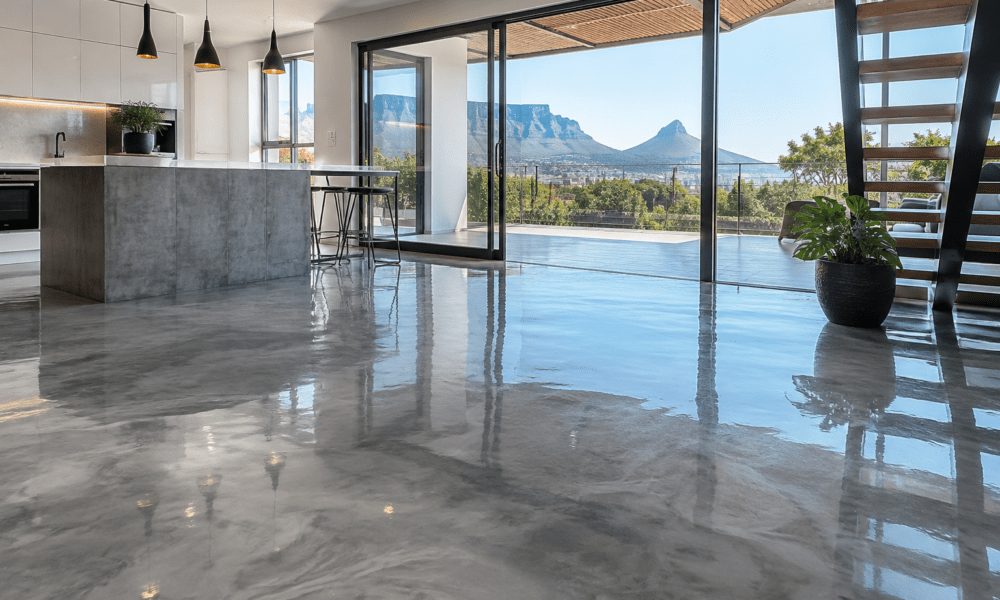
Metallic epoxy uses specialised pigments to create flowing decorative patterns. For example, finishes can be designed to resemble marble, stone or liquid metal.
Consequently, metallic epoxy flooring is particularly popular in:
- Luxury homes
- Restaurants
- Hotels
- Reception areas
- High-end retail spaces
Quartz Epoxy Flooring
Quartz epoxy combines resin with coloured quartz aggregates. As a result, it can provide a textured and durable surface.
It may be suitable for:
- Commercial kitchens
- Wet areas
- Locker rooms
- Schools
- High-traffic environments
Heavy-Duty Industrial Epoxy
Heavy-duty epoxy flooring systems are designed for demanding environments. Therefore, they can be considered where floors experience substantial traffic, impact or chemical exposure.
Most importantly, the system should be specified according to the actual conditions of the facility rather than using a one-size-fits-all approach.
Popular Epoxy Flooring Design Options
Modern epoxy flooring design provides considerable creative flexibility. For example, property owners can choose colours and finishes that complement an existing interior or architectural style.
Popular design options include:
- Solid colours
- Metallic effects
- Marble effects
- Decorative flakes
- Quartz finishes
- Custom colours
- Corporate colours
- Safety markings
- Directional walkways
- Logos and branding
Furthermore, different finishes can produce very different visual results.
A high-gloss finish can create a contemporary appearance. In contrast, a satin finish provides a softer and more understated look.
For properties where colour is important, our guide to screed flooring colours can also provide inspiration when comparing different flooring styles.
The Epoxy Flooring Installation Process
Professional installation is essential for achieving reliable epoxy flooring results. In particular, surface preparation can have a major effect on adhesion and long-term performance.
Step 1: Inspect the Concrete
Firstly, the contractor should assess the existing concrete.
The inspection may identify:
- Cracks
- Moisture problems
- Oil contamination
- Existing coatings
- Surface damage
- Uneven areas
As a result, the contractor can determine which preparation methods are required.
Step 2: Prepare the Surface
Next, the concrete is mechanically prepared using an appropriate method, such as diamond grinding or shot blasting.
This step is particularly important because epoxy needs a suitably prepared surface to bond effectively.
Therefore, simply cleaning the concrete is generally not sufficient for a professional epoxy flooring installation.
Step 3: Repair Damaged Areas
Cracks, holes and damaged sections should be repaired before the epoxy system is installed.
Otherwise, existing defects may affect the finished floor.
For this reason, repairs should form part of the preparation process rather than being treated as an afterthought.
Step 4: Apply the Primer
A suitable primer may be applied to improve adhesion and prepare the concrete for the following layers.
Depending on the system, the primer may also help seal the substrate.
Step 5: Install the Epoxy System
The epoxy flooring system is then installed according to the project specification.
Depending on the design, this may include:
- Primer
- Base coat
- Decorative flakes
- Metallic pigments
- Quartz aggregate
- Additional resin layers
Furthermore, application thickness can vary according to the intended use and performance requirements.
Step 6: Apply the Protective Topcoat
Finally, a suitable topcoat may be applied where required.
For example, polyurethane or polyaspartic topcoats can be specified for certain applications where additional UV, chemical or abrasion resistance is required.
However, the correct topcoat depends on the complete flooring system and the manufacturer’s recommendations.
Why Professional Epoxy Flooring Installation Matters
Although DIY epoxy kits are available, professional epoxy flooring installation offers significant advantages.
Firstly, professional installers understand concrete preparation. Secondly, they can select products according to the conditions of the site. Furthermore, they can control mixing, application and curing more accurately.
Professional installation can help ensure:
- Appropriate moisture assessment
- Correct surface preparation
- Accurate mixing
- Consistent application
- Suitable coating thickness
- Better finish quality
- Proper curing
Most importantly, poor preparation can lead to adhesion problems, peeling and premature failure.
Therefore, choosing an experienced epoxy flooring contractor is an important part of protecting your investment.
Is Epoxy Flooring Easy to Maintain?
Yes. One of the main benefits of epoxy flooring is its relatively straightforward maintenance.
Routine cleaning can include:
- Firstly, sweep or dust mop the floor regularly.
- Next, remove dirt and grit before they accumulate.
- Then, clean spills promptly.
- In addition, damp mop the surface using a suitable cleaning product.
- Finally, follow the manufacturer’s recommendations for periodic maintenance.
Because epoxy flooring can create a seamless surface, there are no traditional grout lines between tiles. As a result, there are fewer joints where dirt can collect.
However, cleaning products should always be compatible with the specific flooring system.
Common Epoxy Flooring Myths
There are several misconceptions about epoxy flooring. However, understanding how the system works can help property owners make better decisions.
Myth 1: Epoxy Flooring Is Always Slippery
This is not necessarily the case.
In fact, suitable anti-slip aggregates can be incorporated into epoxy systems to improve traction.
Therefore, discuss slip resistance with your flooring contractor, particularly for wet areas and high-traffic environments.
Myth 2: Epoxy Flooring Is Only for Factories
Epoxy was traditionally associated with industrial environments. Today, however, decorative epoxy flooring is also used in homes, restaurants, offices, showrooms and retail spaces.
As a result, homeowners and businesses can combine practical performance with attractive design.
Myth 3: Epoxy Flooring Cracks Easily
Epoxy itself is a durable material. However, the concrete substrate beneath it can crack or move.
Therefore, substrate condition, crack repair and appropriate system selection are important before installation.
Epoxy Flooring for Cape Town Properties
Cape Town has a diverse property market ranging from modern homes and apartments to restaurants, offices and large industrial facilities. Consequently, flooring requirements can vary considerably from one project to another.
For example, a residential garage may benefit from a decorative flake system, while a warehouse may require a heavy-duty industrial specification.
In addition, moisture, sunlight, coastal conditions, traffic and the intended use of the space should all be considered when selecting epoxy flooring.
If you are comparing different flooring systems for a Cape Town property, explore our flooring solutions to learn more about available options.
Epoxy Flooring Design for Homes and Businesses
The design flexibility of epoxy flooring makes it suitable for many environments.
For residential properties, homeowners can choose neutral colours, decorative flakes or metallic finishes.
For commercial properties, businesses can incorporate brand colours, safety markings or custom design elements.
Meanwhile, industrial facilities may prioritise performance, safety and durability over decorative effects.
As a result, the same flooring technology can be adapted to very different project requirements.
Why Businesses Choose Epoxy Flooring
Commercial and industrial property owners often choose epoxy flooring because it can combine practical performance with a professional appearance.
Key benefits include:
- Durability
- Easy cleaning
- Chemical resistance
- Seamless appearance
- Low maintenance
- Design flexibility
- Long service life
- Suitable options for high-traffic areas
Furthermore, a durable floor can help reduce the frequency of major repairs and replacement.
Consequently, epoxy can provide good long-term value when the correct system is professionally installed and maintained.
Sustainability and Epoxy Flooring
Floor longevity can contribute to more sustainable building practices. For example, a durable floor that remains serviceable for many years may reduce the need for frequent replacement.
In addition, protecting an existing concrete slab can extend the useful life of the underlying surface.
However, sustainability depends on the complete flooring system, product selection, installation practices and eventual disposal. Therefore, environmental considerations should form part of the overall flooring decision.
How Long Does Epoxy Flooring Last?
The lifespan of epoxy flooring varies according to several factors.
These include:
- Product quality
- Surface preparation
- Installation workmanship
- Traffic levels
- Chemical exposure
- UV exposure
- Maintenance
- Flooring system specification
For example, a residential garage may experience very different conditions from a warehouse with constant forklift traffic.
Therefore, there is no single lifespan that applies to every epoxy floor.
With professional installation, suitable products and regular maintenance, many epoxy flooring systems can provide years of reliable service.
How Much Does Epoxy Flooring Cost?
The cost of epoxy flooring depends on the specific project. For this reason, an accurate quotation normally requires an assessment of the area.
Factors that can influence the price include:
- Floor size
- Existing concrete condition
- Surface preparation
- Repairs required
- Epoxy system selected
- Number of coats
- Decorative finish
- Protective topcoat
- Site conditions
As a result, two properties with the same floor area can have significantly different installation costs.
Therefore, it is better to compare complete specifications and quotations rather than selecting a contractor based solely on the lowest price.
How to Choose an Epoxy Flooring Contractor
Choosing the right installer is just as important as choosing the correct epoxy flooring system.
Firstly, look for experience with projects similar to yours. Secondly, ask to see completed work. In addition, find out what surface preparation equipment and methods the contractor uses.
Consider:
- Previous projects
- Industry experience
- Product quality
- Surface preparation
- Flooring specifications
- Warranty information
- Customer reviews
- Maintenance recommendations
Most importantly, ask questions about the complete installation process.
A reputable contractor should be able to explain how the concrete will be prepared, which system is recommended and why it is suitable for your property’s intended use.
Frequently Asked Questions About Epoxy Flooring
Is Epoxy Flooring Suitable for Homes?
Yes. In particular, epoxy flooring can work well in garages, workshops, home gyms, entertainment areas and other spaces requiring a durable surface.
Is Epoxy Flooring Suitable for Garages?
Absolutely. In fact, garages are one of the most popular residential applications because epoxy can provide a durable and easy-to-clean surface.
Is Epoxy Flooring Waterproof?
Epoxy creates a protective coating over suitable concrete. However, it should not be treated as a complete solution for underlying water or moisture problems.
Therefore, moisture assessment and substrate preparation remain important.
Is Epoxy Flooring Slippery?
It can become slippery when contaminated with water or other liquids. However, suitable anti-slip aggregates and textures can be incorporated into the system to improve traction.
Can Epoxy Flooring Be Coloured?
Yes. Furthermore, epoxy flooring is available in a wide range of colours and decorative finishes.
Options include:
- Solid colours
- Metallic colours
- Decorative flakes
- Quartz
- Custom colours
How Do You Clean Epoxy Flooring?
Generally, regular sweeping or dust mopping followed by occasional damp mopping is sufficient for routine cleaning.
However, always use cleaning products that are compatible with the specific flooring system.
How Long Does Epoxy Flooring Take to Install?
The installation time depends on the size and condition of the floor, preparation requirements, number of coats and curing times.
Therefore, your flooring contractor should provide a project-specific installation schedule.
Final Thoughts on Epoxy Flooring
Epoxy flooring has evolved from a predominantly industrial flooring system into a versatile solution for residential, commercial and industrial properties.
Today, homeowners and businesses can choose from solid colours, decorative flakes, metallic finishes, quartz systems and other designs. At the same time, epoxy can provide durability, chemical resistance, easy maintenance and a seamless appearance.
However, the quality of the final result depends heavily on preparation and installation. For this reason, selecting the correct flooring system and an experienced installer is essential.
Whether you are upgrading a garage, renovating a restaurant, modernising an office, creating a showroom or protecting an industrial warehouse, epoxy flooring can provide a practical and attractive solution.
Ultimately, the best epoxy floor is not simply the one that looks good. Instead, it should be selected according to the property’s traffic, environment, design requirements and long-term performance needs.
Ready to explore epoxy flooring for your property? Contact Atomic Flooring to discuss your requirements and find the right epoxy flooring solution for your project in Cape Town and the Western Cape.